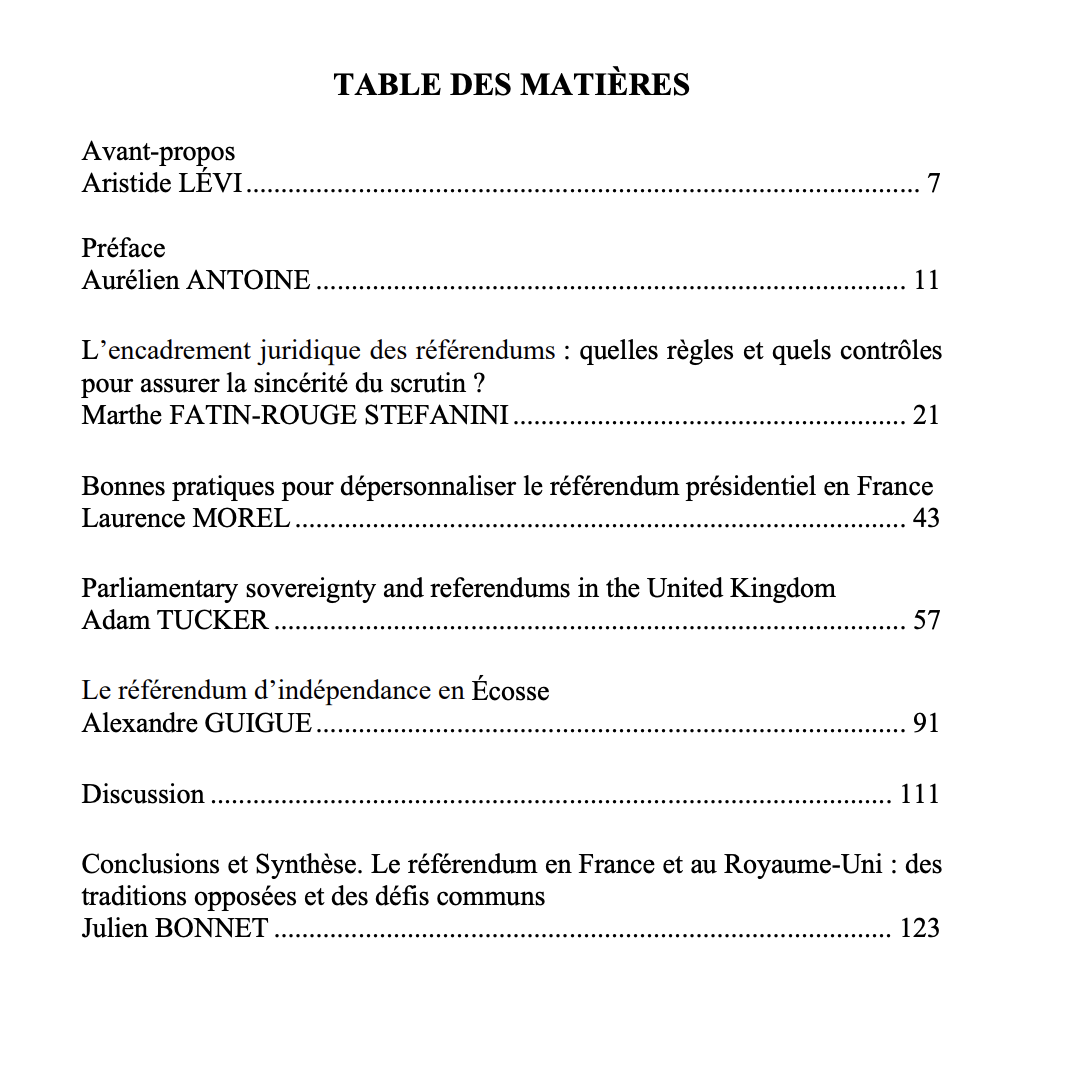
It is with great pleasure that we announce the publication of the proceedings of the conference Le référendum en France et au Royaume-Uni. Enjeux contemporains, which was held on 7 April 2025 at the Palais du Luxembourg under the distinguished patronage of the President of the Senate, Mr Gérard Larcher. This volume was edited jointly by Aurélien Antoine and Aristide Lévi
Among the remedies regularly invoked in contemporary democracies to bridge the gap between governors and governed, the referendum occupies a prominent place. Yet recent referendums in France and the United Kingdom have conspicuously failed to breathe new life into democracy. In 2005, the French electorate’s rejection of the bill ratifying the treaty establishing a Constitution for Europe opened up deep political fault lines. The Brexit referendum, likewise, goes a long way towards explaining the profound institutional and political turmoil the United Kingdom has been living through since 2016. The principle of parliamentary sovereignty had long stood in the way of popular consultation becoming a favoured instrument of constitutional decision-making. The votes of 1975 on membership of the European Communities, of 2016 on membership of the European Union, and of 2014 on Scottish independence nevertheless demonstrate that the referendum has steadily won itself a place in British constitutional law.
Scholarly writing on referendums is abundant, yet surprisingly little of it has focused on French and British practice. That was the animating purpose of the international conference held in April 2025, which returned, from a comparative standpoint, to the fundamental questions the referendum raises in France and the United Kingdom: is it genuinely the most effective means of strengthening democracy? How are we to guard against the growing risks of manipulation in a vote that appeals directly to the citizenry? How can the referendum be squared with the constitutional principles of representative democracy? What part should courts play in scrutinising referendums? This volume gathers contributions from legal scholars and political scientists who take up these questions through a series of contrasting and thought-provoking analyses.
The editors of this volume wish to express their gratitude to the partners without whom neither the conference nor this book would have been possible: the Chaire Droit Public et Politique Comparés, the Faculty of Law of the Université Jean Monnet Saint-Étienne, the Société de Législation Comparée, the CERCRID, the Association Française de Droit Constitutionnel, the Observatoire du Brexit, and the Association des Juristes Franco-Britanniques / Franco-British Lawyers Society.